26.05.2026
Gating pore channelopathies
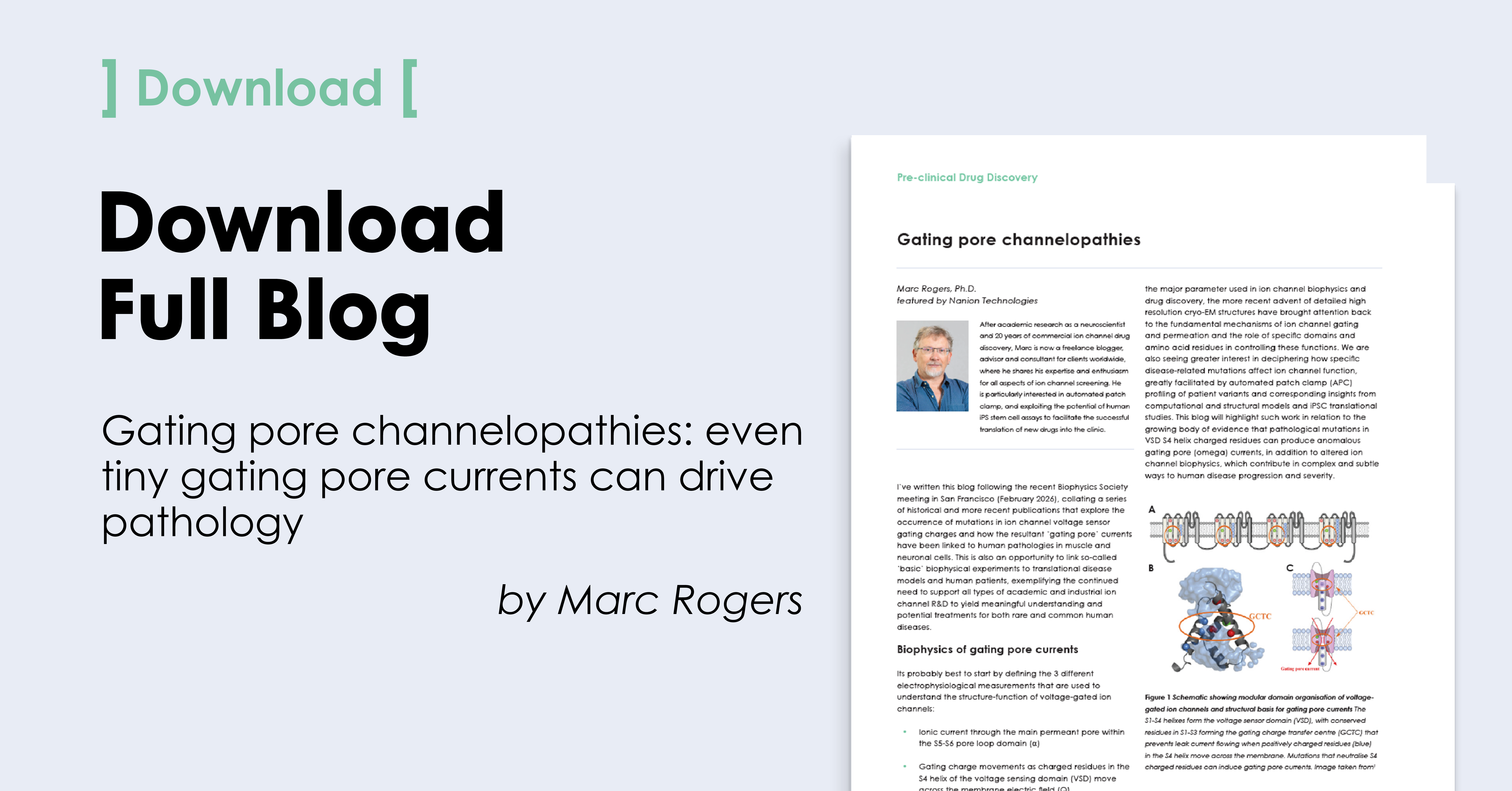
In this latest blog, Marc Rogers explores gating pore channelopathies, highlighting how mutations in ion channel voltage sensor gating charges can produce “gating pore” currents linked to human diseases in muscle and neuronal cells.

After academic research as a neuroscientist and 20 years of commercial ion channel drug discovery, Marc Rogers now works as a freelance blogger, advisor and consultant for clients in the UK, EU and US where he shares his expertise and enthusiasm for all aspects of ion channel screening. He is particularly interested in automated patch clamp, and exploiting the potential of human iPS stem cell assays to facilitate the successful translation of new drugs into the clinic.
The blog reviews the biophysical basis of gating pore currents and how mutations in voltage sensor domains can disrupt normal ion channel function.
The article highlights how S4 helix mutations in channels such as NaV1.4, CaV1.1, NaV1.5, TRPM7, CaV1.3, CaV1.4, KV7.2/7.3, and NaV1.2 contribute to diseases including periodic paralysis, dilated cardiomyopathy, trigeminal neuralgia, aldosterone-producing adenomas, congenital stationary night-blindness, epilepsy, and autism.
Case studies include skeletal muscle myotonias, cardiac myopathy, CNS channelopathies, and recent translational models linking small gating pore currents to altered excitability and disease phenotypes.
The blog also discusses drug discovery opportunities, including pharmacological inhibition, toxin peptides, VSD-targeting antibodies, and emerging gene therapy approaches.
Overall, the blog provides a clear and accessible overview of why gating pore currents represent an important and still-developing class of channelopathies, connecting fundamental ion channel biophysics with translational disease models and potential therapeutic strategies.